Moldova Cyberattack: How to Protect Your Personal Data

Moldova Cyberattack: How to Protect Your Personal Data from Scammers
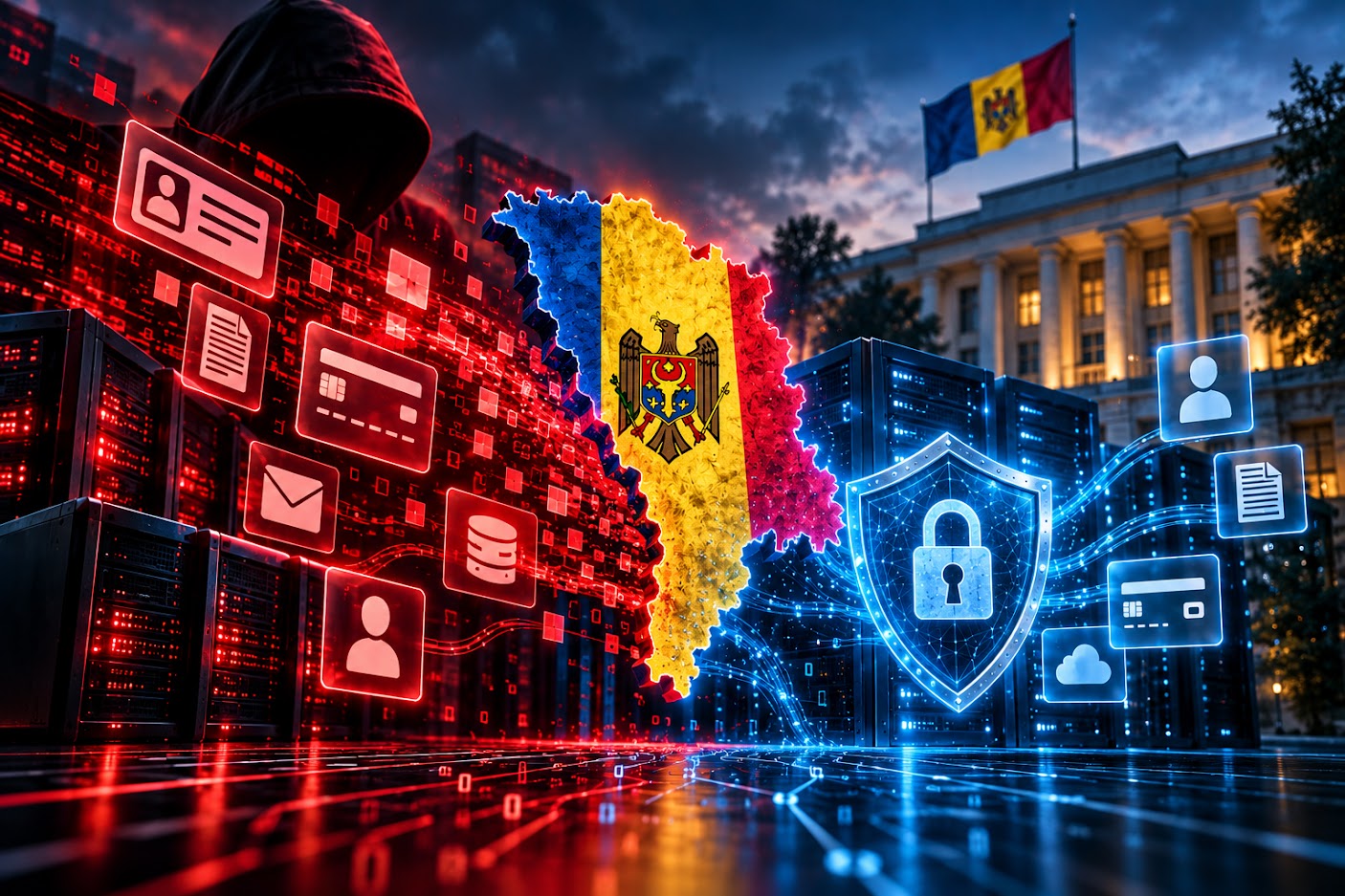
In October 2026, the Republic of Moldova faced a cyberattack targeting several public digital services. The incident raised an important question for citizens: what can happen if personal information falls into the wrong hands, and how can people protect themselves from fraud that may follow a data breach?
The danger is not limited to the internet. Illegally obtained information may be used in phone calls, fake messages and social-engineering attempts. A scammer who knows your name, national identification number (IDNP) or certain details about your family may sound convincing, especially when pretending to represent a bank or government institution.
What happened during the cyberattack?
According to information published by Moldova’s Electronic Governance Agency on 24 October 2026, the attack took place during the night of 22 October and targeted several public digital services. Approximately 11 million access requests were recorded in an attempt to obtain personal data without authorization. Authorities detected unusual activity, disconnected the affected services as a precaution, and stopped the unauthorized data extraction on 23 October.
On 27 October, preliminary findings indicated that queries had targeted approximately one million IDNPs, while datasets associated with around 750,000 IDNPs were reportedly extracted. These figures are preliminary estimates, and the exact scope of the incident remains under investigation.
Authorities said the information involved could include identification details, information about family members, health-insurance status, social benefits and pensions, driving licences, vehicles, companies, and certain financial information, including IBANs and some payment history. However, this does not mean that every listed category was exposed for every individual. Follow confirmed updates from the Electronic Governance Agency.

What risks does this create for ordinary citizens?
One significant risk is the use of personal information to gain a victim’s trust. Scammers may combine real details with an invented story to persuade someone to reveal more information, share an authentication code or transfer money.
For example, someone may call and claim to be a bank employee, police officer or government representative. The caller may know your name and IDNP and say that your account needs to be “protected”, a payment must be confirmed, or a suspicious transaction must be stopped. Knowing real details about you does not prove that the caller represents an official institution.
Older people and pensioners may be targeted with calls designed to create fear or urgency. A scammer might claim that a pension is at risk, that there is a problem with official documents, or that a relative has been in an accident and urgently needs money. The aim is to make the person act before checking whether the story is true.
How to check whether your personal data was accessed after the cyberattack
Citizens can review their personal-data access history in the government EVO app or through the MCabinet portal. This may help identify access records they do not recognize, but the results must be interpreted carefully: an unusual entry does not automatically prove that hackers extracted your data.
How to check the history in the EVO app:
- Open the official EVO app and sign in using an authentication method currently available to you.
- Go to the “Contul tău” (“Your account”) section.
- Find “Istoricul accesării datelor” (“Data access history”).
- Review the listed institutions, access dates and stated reasons. If you see an entry you cannot explain, record its details so you can request clarification.
You can also check the relevant data-access history section in MCabinet, if the service is available to your account. Use only the official app and government portals. Do not follow links in unsolicited text messages from people claiming they can check whether your information was exposed.
Important: The Electronic Governance Agency explained that, in the context of the incident, some history entries could incorrectly state the legal basis for data access, including entries related to requests for civil-status documents or driving-licence issuance. Therefore, an unusual entry alone is not proof that your data was stolen. Conversely, seeing no suspicious entry does not guarantee that your data was never at risk.
If you find access records you cannot explain, note the date, institution and stated reason, then request clarification through the official channels of the Electronic Governance Agency. Do not post screenshots containing your IDNP or other personal information in public comments or send them to strangers.
How to protect yourself from fraudulent calls and messages
Follow a few basic rules, even if the caller seems well-informed and sounds convincing:
- Never share passwords, authentication codes, your card PIN, CVV or full bank-card details.
- Never transfer money to a so-called “safe account” to protect your funds. This is a strong warning sign of fraud.
- Do not install apps or grant remote access to your phone or computer at the request of an unknown caller.
- Do not open suspicious links sent through SMS, email or messaging apps.
- If someone claims to represent your bank or a public institution, end the call and contact the organization using a number published on its official website or on your bank documents.
- If the caller pressures you to act immediately, stop the conversation and verify the situation independently.
How to protect your parents and older relatives
Talk to older family members about these risks. Explain that someone who knows their name, IDNP, address or certain details about their pension is not automatically trustworthy. Real information can be used to make a fabricated story sound believable.
Agree on a family rule: nobody transfers money, shares codes or makes financial decisions after an unexpected call without checking the situation with someone they trust. If the caller claims to be a relative in trouble, call that relative using a number you already know.
Do not blame someone for receiving a suspicious call. Help them preserve messages, phone numbers, call times and other evidence. If bank details were disclosed or a transfer was made, contact the bank immediately through official channels and report the incident to the police.
Personal data and financial safety: what you should know
Authorities stated that bank-card information was not affected by the reported incident. Card payments through MPay and EVO are processed through banking systems. Simply knowing an IBAN also does not automatically provide access to a bank account or enable an unauthorized transfer.
However, personal and financial details can help scammers create more convincing fraud attempts. Treat unexpected requests for money or confidential information with caution, and always verify them through an independent channel.
What to do if scammers have already contacted you
If you receive a suspicious call or message, do not follow the caller’s instructions and do not immediately delete the evidence. Keep the phone number, message, screenshots and details of any possible transaction. Report the incident to the competent authorities. If you shared banking information or approved a payment, contact your bank immediately through its official channels.
For information about the cyberattack, consult official announcements, including the Electronic Governance Agency statement of 27 October 2026. Avoid spreading rumours or unverified claims.
Conclusion: awareness is your best protection
A cyber incident does not mean that every citizen will become a victim of fraud. However, it is sensible to review your data-access history in EVO or MCabinet, remain cautious about unexpected calls, and never reveal confidential information simply because a caller seems to know details about you.
Help your parents and grandparents learn to recognize scams. Remind them that urgency over the phone is never a substitute for verification. A few minutes of caution can prevent financial losses and the disclosure of additional personal information.
Have a Project in Mind?
Tell us about your project and we will help you find the best solution.