
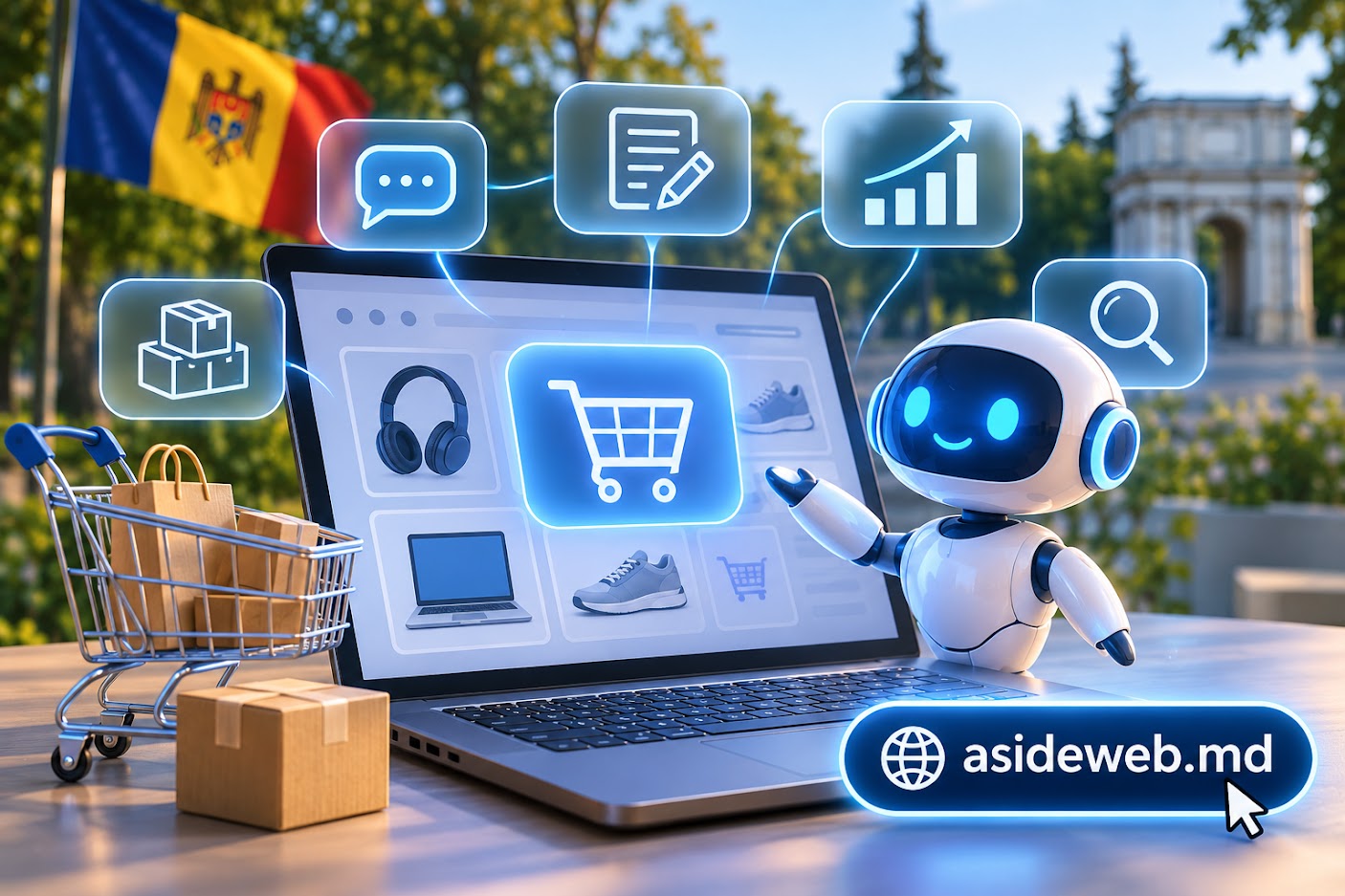
How Artificial Intelligence Is Changing E-commerce in Moldova

Artificial intelligence is gradually changing the way e-commerce operates. Today, AI is used for more than generating text and images. When properly integrated into an online store, it can help manage product catalogues, process common customer questions, identify sales patterns and simplify selected business operations.
These technologies are becoming increasingly relevant for businesses in the Republic of Moldova. Online stores need to manage products, stock levels, orders, deliveries, payments and customer enquiries. Some of these activities are still handled manually or through several separate systems.
AI integrations can help make these processes more efficient. However, it is important to distinguish between the technology’s actual capabilities and exaggerated marketing claims. This article explores where AI can be useful for Moldovan online stores, which tasks can be automated and what should be prepared before implementation.
E-commerce in Moldova: the current situation
To understand the opportunities offered by AI, it is important to consider the local market. According to AmCham Moldova’s report, “The E-Commerce Market in Moldova in 2025”, published in 2025, approximately 2,800 online platforms operated in the Moldovan market in June: 1,806 online stores selling physical goods and 997 platforms offering commercial services.
The report also identified more than 160 platforms with shopping carts that did not accept bank card payments. This demonstrates that e-commerce development involves more than launching an online store. Payment infrastructure and the user experience also need attention.
Payment methods are another important aspect. According to the report’s 2024 data, cash or card payment upon delivery accounted for 65.4% of the value of the online product sales examined, while online bank card payments accounted for 11.9%. This makes order confirmation, customer communication and delivery management particularly important for local stores.
The report also highlights discrepancies between stock levels displayed on websites and the actual availability of products. AI can help process and analyse this information, but only when the underlying data comes from reliable and up-to-date sources.
1. AI-powered product descriptions and catalogue management
Online stores with large product ranges regularly update product names, specifications, descriptions and other information. When a catalogue contains hundreds or thousands of items, preparing this content manually can take considerable time. The task becomes even more complex when a store operates in several languages.
An AI integration can use existing product specifications to generate descriptions, improve wording, create titles and adapt information into Romanian, Russian or English. For example, based on a laptop’s technical specifications, the system can prepare a more accessible description for potential buyers rather than simply repeating a list of technical parameters.
There is an important limitation: AI should not invent product specifications, included accessories, warranty conditions or product benefits. All commercially relevant information must be checked before publication.
2. AI assistants for customer communication
Customers often ask about product availability, delivery times, payment methods and return policies. When an online store receives many similar questions every day, employees have to spend time providing repetitive answers.
An AI assistant connected to the store’s current information can answer common questions about products, opening hours, delivery and returns. It can operate directly on the website and assist visitors outside normal business hours.
For Moldova, support for Romanian and Russian is particularly relevant. However, the assistant must rely on the store’s actual information rather than assumptions. If a question is complex or the necessary information is unavailable, the system should offer the customer a way to contact an employee.
3. Order automation and information exchange
An online store does not operate independently of the company’s other business processes. After an order is placed, its details and product availability need to be checked, the parcel prepared, delivery information transferred and the customer supported throughout the process.
When employees manually transfer the same information between several applications, delays and errors can occur. API-based data exchange makes it possible to connect an online store with accounting and other internal systems. AI can complement this infrastructure by classifying enquiries, identifying messages that require attention, summarising conversations and preparing operational reports.
For example, when a customer asks about an order, a system can identify the type of enquiry and prepare a short summary for the employee. This helps the team understand the situation more quickly without manually reviewing the entire conversation history.
It is important to distinguish ordinary automation from artificial intelligence. Product, price, stock and order synchronisation is generally performed through predefined rules and APIs. AI is not required for these operations. It becomes useful when information needs to be analysed, enquiries classified, patterns identified or responses prepared.
4. Intelligent product search and recommendations
Customers do not always find it easy to locate a product in stores with many categories. A traditional search engine based only on exact keyword matching may fail to understand the meaning of a query or alternative product names.
AI-powered search can interpret requests written in natural language. For example, instead of entering an exact model name, a customer might search for “a laptop for work and video conferences”. The system can identify suitable products if the catalogue contains properly structured specifications.
Recommendations can also take into account product categories, specifications, browsing history and items frequently purchased together. A well-organised and up-to-date product catalogue is essential for these tools to produce relevant results.
5. Sales analysis and stock planning
Sales data helps businesses understand which products are in demand, which categories are affected by seasonal changes and at which stages order cancellations occur more frequently. AI can analyse sales history and identify patterns that may be difficult to notice manually when dealing with large amounts of information.
For example, an online store can compare sales across different periods, identify products with growing demand and estimate replenishment requirements. These insights can support management decisions, but they do not guarantee accurate predictions of future sales.
The quality of the analysis depends on the completeness of order history, the accuracy of the source data and external factors such as seasonality, prices, promotions, product availability and competitor activity.
A real example from Moldova: payments initiated by AI agents
An interesting example of this development appeared in July 2026. Mastercard announced a pilot project in the Republic of Moldova involving payments initiated by AI agents, in collaboration with maib and Moldindconbank. The initiative was presented as a step towards a model of commerce in which AI agents can act on behalf of customers while meeting requirements for authentication, transparency and user control.
It is important to understand what this example means. It was a pilot project, not proof that all Moldovan online stores can already accept autonomous payments through AI agents. Nevertheless, it demonstrates that the local financial infrastructure is beginning to test new ways for customers, intelligent systems and payment services to interact.
What should be prepared before implementing AI?
Implementing artificial intelligence does not begin with installing a chatbot. First, an online store needs organised processes and reliable data on which the technology can operate correctly.
- An up-to-date product catalogue with accurate names, descriptions and specifications.
- Reliable information about stock, prices, delivery and returns.
- A clear process for handling orders and customer enquiries.
- APIs or other secure methods of exchanging data between systems.
- Clear rules defining AI access to information and permitted actions.
- Employee review of actions that may affect orders, payments or customer relationships.
Personal data protection and AI limitations
Online stores process customer details, order information, delivery addresses and, in some cases, payment-related information. Sending such data to public AI tools or external services without first evaluating security and data-processing conditions should not be considered a safe practice.
Companies in the Republic of Moldova must take applicable personal data protection legislation into account, including Law No. 195/2024 to the extent that it applies to the relevant processing. Before implementation, businesses should determine the legal basis and purposes of processing, access arrangements, security measures and the conditions for transferring information to external providers.
AI can make mistakes, misinterpret requests or use outdated information. For this reason, it should not be allowed to approve returns, change prices, confirm stock availability or execute payments independently without strict rules and control mechanisms.
Should Moldovan online stores invest in AI?
Not every online store needs a complex AI system immediately. For a small business with a limited catalogue and a relatively low number of orders, automating product updates, notifications and order processing may be sufficient. More advanced AI integrations become relevant when there is a large volume of data, many repetitive enquiries or processes that consume too much staff time.
A practical approach is to start with one specific problem whose results can be measured. For example, reducing response times, speeding up the preparation of multilingual descriptions, classifying enquiries or analysing sales. After a trial period, the business can compare time spent, error rates and operating costs with the initial situation.
Conclusion: AI should solve real problems, not just impress
Artificial intelligence integrations can contribute to the development of e-commerce in the Republic of Moldova. They can simplify repetitive operations, improve customer communication, analyse data and make selected business processes more efficient.
However, technology cannot automatically fix a disorganised catalogue, inaccurate stock levels, delivery problems or a lack of customer trust. Results depend on the quality of the digital infrastructure and how effectively AI is integrated into the company’s actual processes.
For Moldovan online stores, the next step should not be adopting artificial intelligence simply because it is a modern trend. It is more important to identify processes that genuinely need improvement and choose technologies that deliver concrete, measurable and sustainable benefits.
Have a Project in Mind?
Tell us about your project and we will help you find the best solution.